
Water tracks straight to the structure
A split valley or a chimney tray with a lost cover flashing gives water a direct path past the covering onto battens, rafters and ceilings, with none of the resistance a sound tiled or slated area provides.
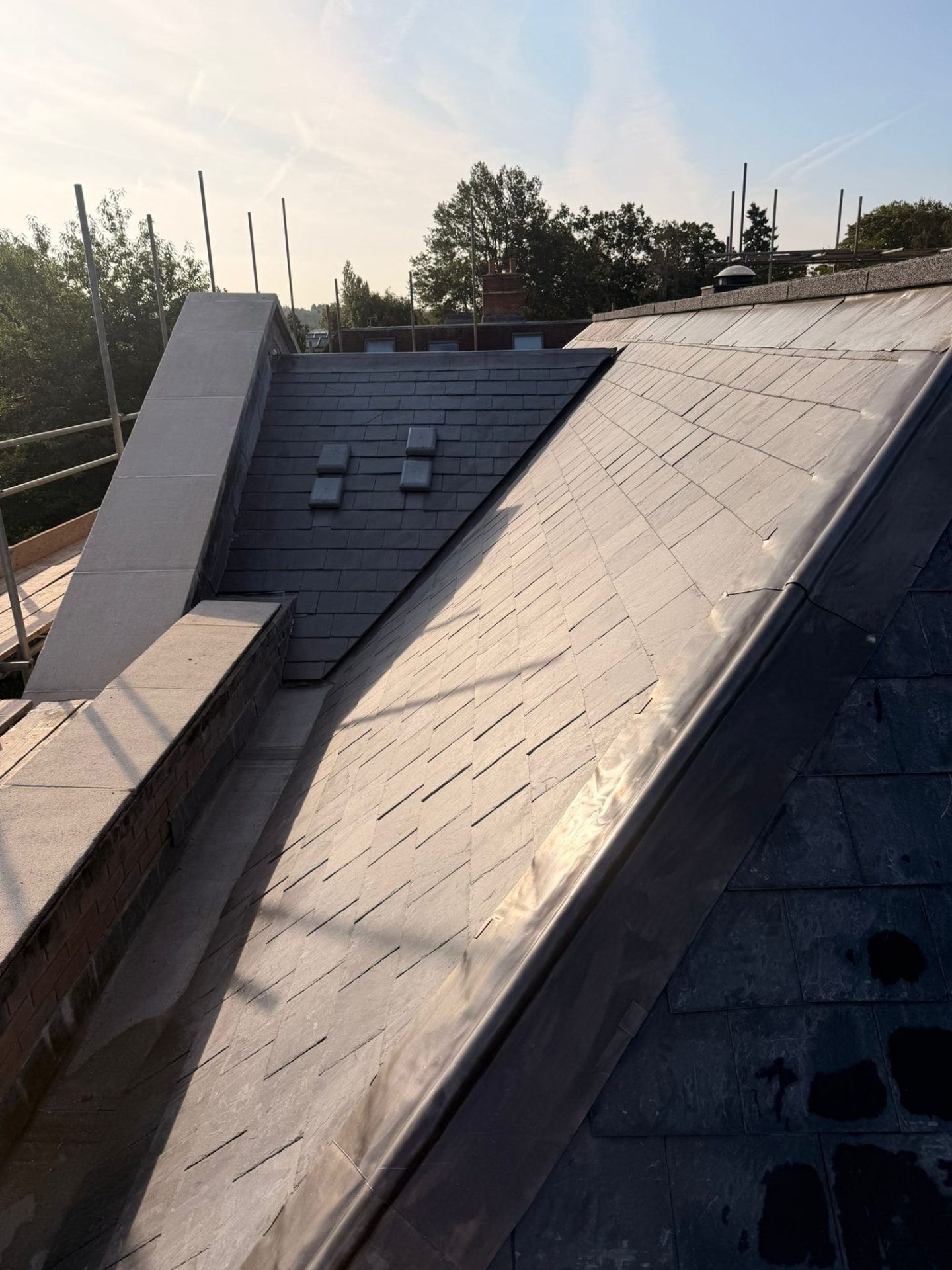
Most roof leaks start at a lead detail, not in open field. Correctly coded, laid and dressed lead at valleys, chimneys, abutments and bay tops is what actually keeps water out, and we fit it by hand to last.
Traditional materials specialists · Photographic report on every inspection · Fixed-price quotes, never a day rate
15+ years
Experience, with 30+ combined years across the team
£2 million
Public liability insurance cover
10-year guarantee
Workmanship guarantee on re-roofs, new roofs and major works
Fixed price
Quoted work only, never a day rate
Photo report
Photographic evidence with every inspection
Recent work
Service overview
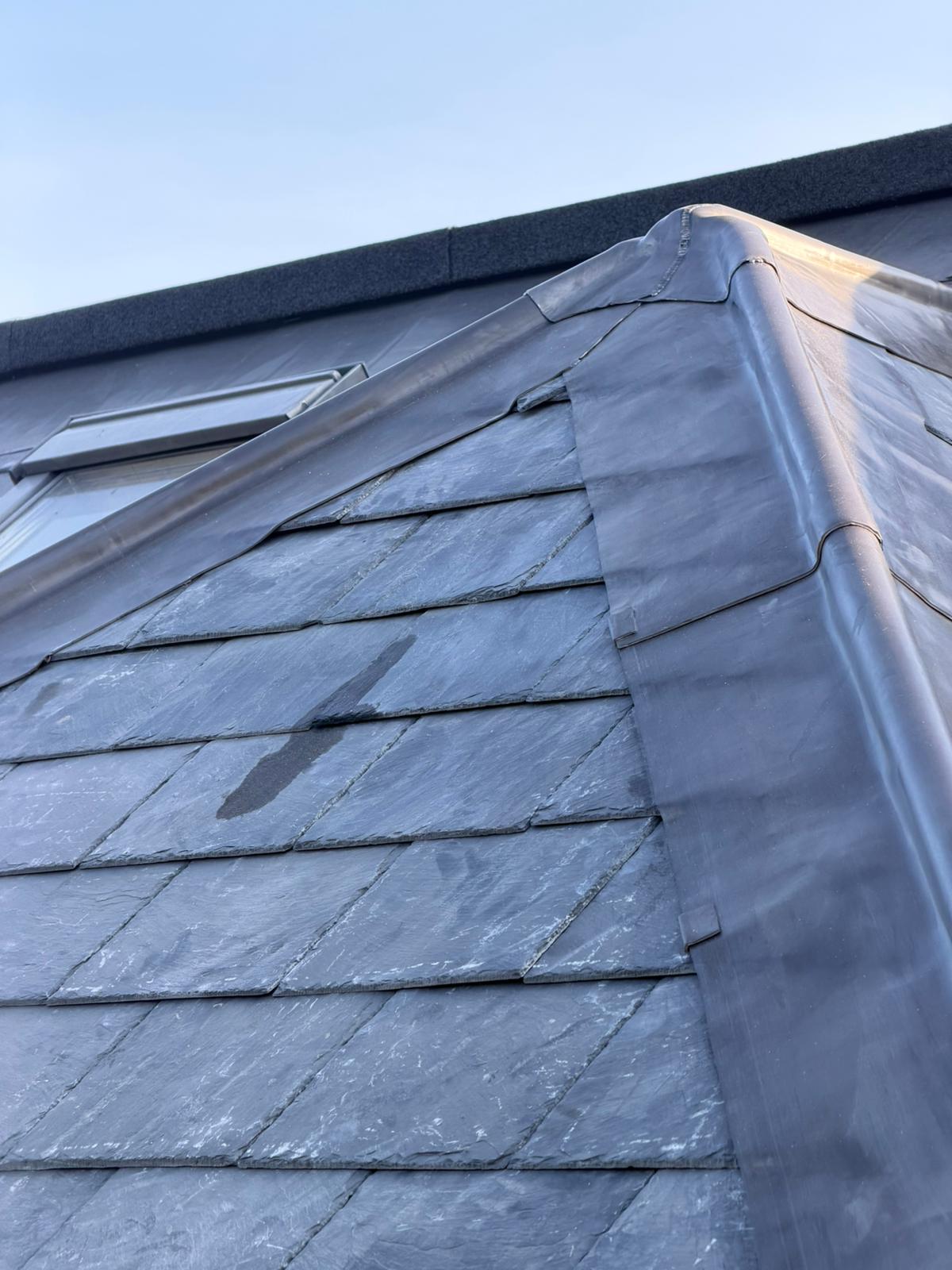
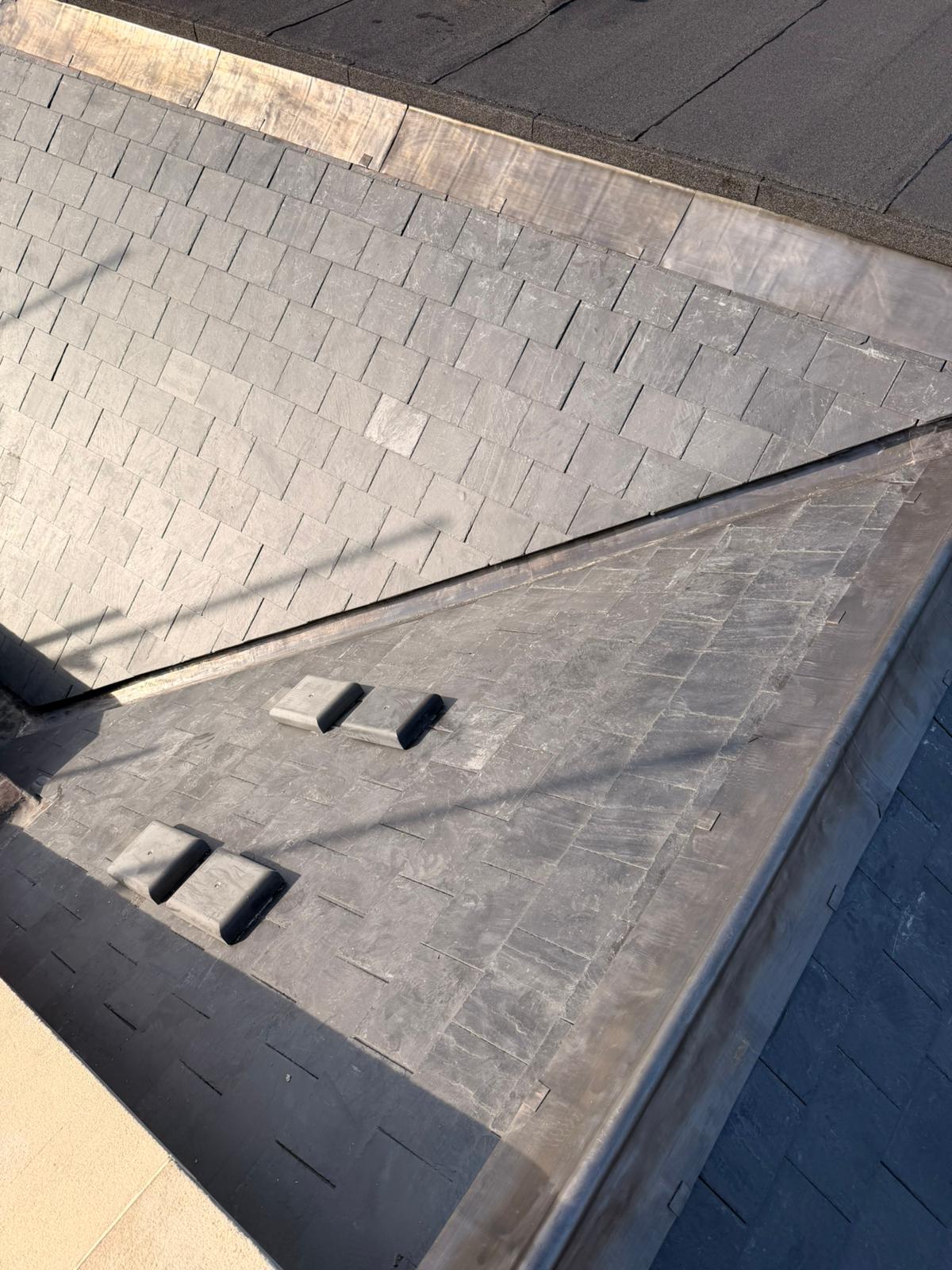
Leadwork is the flexible, hand-dressed metalwork that seals every junction a tiled or slated covering cannot seal on its own: valleys where two roof slopes meet, chimney trays and back gutters, step and cover flashings against walls, soakers between tiles at abutments, and box gutters and parapet linings on flat and near-flat sections. It also covers bay window tops, dormer cheeks and any point where a roof meets a vertical surface or changes direction.
Lead is used because it can be dressed and welted by hand into complex shapes, moves with the roof through thermal expansion and contraction without cracking, and, correctly detailed, lasts far longer than the covering around it. That durability depends entirely on getting the code (thickness), the bay sizes and the laps right for the exposure and the pitch involved. Undersized lead laid in bays that are too large will split from thermal movement within a few winters; correctly sized lead in properly spaced bays can outlast the roof it is fitted to.
We fit and repair leadwork on new roofs, re-roofs, repairs and standalone flashing replacement, matching sand-cast lead where a period or listed building calls for it and milled lead where it is the appropriate, cost-effective choice. Every piece is measured, cut and dressed for the specific roof rather than bent from a generic template.
The cost of leaving it
Lead details carry a disproportionate share of a roof's weatherproofing for their size. When one fails, water has a direct route into the building, and the surrounding covering and structure take the damage while the fault stays hidden.
A split valley or a chimney tray with a lost cover flashing gives water a direct path past the covering onto battens, rafters and ceilings, with none of the resistance a sound tiled or slated area provides.
Mortar filleting and bituminous sealant applied over failing lead trap moisture behind the patch, accelerate corrosion and hide the real extent of the damage until it reappears indoors.
A leaking valley or soaker keeps the neighbouring tiles or slates permanently wet, and freeze-thaw cycles then break down units that had years of life left, widening the repair every winter it is left.
Chimney back gutters and abutment flashings sit above habitable rooms more often than open roof field does, so a failure here tends to reach ceilings and insulation faster than a slipped tile in open field.
On listed and conservation-area buildings, delaying a proper repair increases the temptation to accept a cheaper, non-matching substitute once damage has spread: undermining the building's appearance and, in some cases, conservation requirements.
Our process
We inspect every lead detail on the roof: valleys, chimney trays, step and cover flashings, soakers, box gutters, parapets and bay tops, and trace any leak back to its actual source. Free in most cases; jobs needing special access to inspect safely may differ and we tell you before we attend.
You receive a photographic report of the lead's condition and the water path where a leak is involved, so the fault is evidenced rather than assumed.
One figure for the specified leadwork: code, sand-cast or milled, bay sizes and laps, agreed in writing before we start. No day rates, and staged payments for projects beyond five days.
Typically two to three of our tradespeople on site. Lead is measured, cut and hand-dressed for the specific detail, with bays and laps sized to allow for thermal movement, and the surrounding covering protected and reinstated as we go.
We check every joint and lap, clear the site and walk the finished work with you, with photographs of the completed leadwork. Major leadwork on re-roofs and new roofs carries our 10-year workmanship guarantee; smaller flashing repairs are confirmed in writing for your specific job.
What you get
Correct code and properly sized bays and laps mean the lead can expand and contract with temperature without cracking, which is the single biggest cause of premature leadwork failure.
Because most leaks originate at leadwork rather than in open field, checking these details first, with two to three tradespeople on site, gets a leak stopped without unnecessary work elsewhere on the roof.
Every quote states the code, the extent of lead and the detail specified. No day rates, so the figure you sign off is the figure you pay.
Correctly coded and laid lead, hand-dressed rather than machine-bent to a generic shape, is built to outlast the surrounding covering rather than be the first thing to fail again.
Sand-cast lead specified where a period or listed property calls for it, so the repair or new work sits correctly with the surrounding fabric rather than looking like a modern patch.
A photographic report of the finished leadwork, plus a 10-year workmanship guarantee on major leadwork carried out as part of a re-roof or new roof.
The detail
Lead performs well only when the code, the bay sizes and the detailing at each junction are matched to the pitch, the exposure and the building. The following covers the specifics that determine whether leadwork lasts or fails early.
Lead is specified by code, referring to its thickness and weight per square metre, heavier codes for high-exposure details like valleys and box gutters, lighter codes for soakers and step flashings where movement and load are lower. Using too light a code on an exposed detail is one of the most common causes of early splitting.
Sand-cast lead is produced by traditional casting methods, giving a slightly textured, uneven surface historically associated with older buildings; it is specified on listed and conservation-area work where matching the building's original fabric matters. Milled (rolled) lead is more uniform and is the appropriate, cost-effective choice for the majority of standard residential and commercial work where matching a historic texture is not a requirement.
Lead expands and contracts significantly with temperature. If it is laid in one continuous piece over too great a length, that movement has nowhere to go and the lead splits, usually along a straight line where it has fatigued.
The solution is dividing the run into bays of a size appropriate to the code and exposure, each with a properly formed lap or welted joint that allows adjoining pieces to move independently while still shedding water. Getting bay sizes right is a specification decision made before any lead is cut, not something corrected after the fact.
A valley carries the combined water of two roof slopes, so it is one of the highest-flow, highest-wear leadwork details on a roof. Lead valleys are laid in bays with a raised welted edge (or timber roll) to prevent water tracking under the adjoining tiles or slates, particularly in heavy rain.
Box gutters and parapet gutters, common on older terraces, extensions and commercial buildings, carry water along a channel behind a parapet or between two roof sections and need adequate falls, outlets sized for the catchment area, and upstands high enough to cope with debris and overflow before it reaches the building's interior.
Soakers are individual pieces of lead woven between tiles or slates at an abutment, one per course, directing water down and away from the wall junction rather than letting it track sideways under the covering. They are concealed once tiling is complete and are only visible if lifted or if a step flashing above them has failed.
Step flashings sit over the soakers, dressed into the mortar joints of the adjoining wall in a stepped pattern that follows the roof pitch, while cover flashings perform a similar role at chimneys and larger abutments, dressed into a raked-out mortar joint and wedged or pointed in to hold their position and shed water clear of the joint below.
A chimney tray (or back gutter) sits behind a chimney stack, collecting water running down the roof above it and directing it around the stack rather than allowing it to pond against the brickwork; undersized or poorly formed trays are one of the most frequent causes of chimney-related leaks.
Parapet walls need lead upstands and cover flashings dressed into the coping to stop water getting behind the wall face, and bay window tops, often flat or gently pitched, rely on lead aprons and upstands dressed against the main roof and window frame to keep water off the timber below.
On homes, leadwork is usually concentrated at valleys, chimneys and bay tops, and matching sand-cast lead is common on period and listed properties where planning or conservation requirements apply. On commercial and mixed-use buildings, box gutters, parapets and larger flat-roof upstands feature more heavily, often over trading premises where access has to be planned around business hours.
On listed buildings specifically, lead specification, code, bay size, whether sand-cast or milled, may be a genuine requirement rather than a preference, and we specify and quote accordingly rather than defaulting to whichever material is quickest to source.
Questions
Something not covered here? Call 07711 933023 and ask. We would rather answer it honestly on the phone than have you guess.
It depends on the detail involved, a soaker repair is a different job to a full valley or box gutter replacement, which is why we inspect and quote in writing rather than pricing over the phone. Every quote is fixed price, agreed before work starts.
Quotes and inspections are free in most cases. Jobs needing special access to inspect safely may differ, and we tell you that before we attend.
A single valley or flashing repair is often completed in a day; larger areas of box gutter or multiple details take longer. We give you an expected duration with the written quote.
Inspection with a photographic report, a fixed-price written quote specifying the code and extent of lead, the works with two to three tradespeople typically on site, verification of every joint and lap, and sign-off with photographs.
Our 10-year workmanship guarantee applies to major leadwork carried out as part of re-roofs and new roofs. Smaller flashing repairs are not covered by that guarantee unless confirmed otherwise in writing for your specific job.
Correctly coded lead, laid in properly sized bays with sound laps, should last for decades, often outlasting the surrounding tiled or slated covering. Undersized lead or oversized bays are the usual reasons leadwork fails early, which is why we specify to the detail rather than to a generic template.
Sand-cast lead is traditionally cast with a slightly textured surface and is specified on period, listed and conservation-area work to match original fabric. Milled (rolled) lead is more uniform and is the appropriate, cost-effective choice for the majority of standard work.
Emergency repairs are available for storm damage and leaks, including displaced or stolen lead. We will tell you honestly when we can attend rather than promise a response time we cannot guarantee.
Yes, period, listed and conservation-area roofs are a specialism, and we specify sand-cast lead and matching detailing where the building calls for it.
We work from Maidenhead across Berkshire, Buckinghamshire, Surrey, Hampshire and Oxfordshire, including Reading, Windsor, Slough, High Wycombe and Henley-on-Thames. Just outside that? Call and we will tell you honestly whether we can help.
Where we work
Related services
Chimneys move independently of the roof around them, sit fully exposed to weather on all sides, and rely on flashings and flaunching that fail quietly for years before anyone notices.
A leak is stopped once when the water path is traced properly, and paid for twice when it is patched where the damp shows.
Most flat roof failures are not a bad membrane, they are bad falls, a blocked outlet or an upstand that was never dressed correctly.
View all services
Next step
Book an inspection and you will get a photographic report of every lead detail on your roof and one fixed price for whatever needs doing. Free in most cases, and no obligation to proceed.
151 Larchfield Road, Maidenhead, Berkshire, SL6 2SJ · Mon–Sat, 7am–10pm